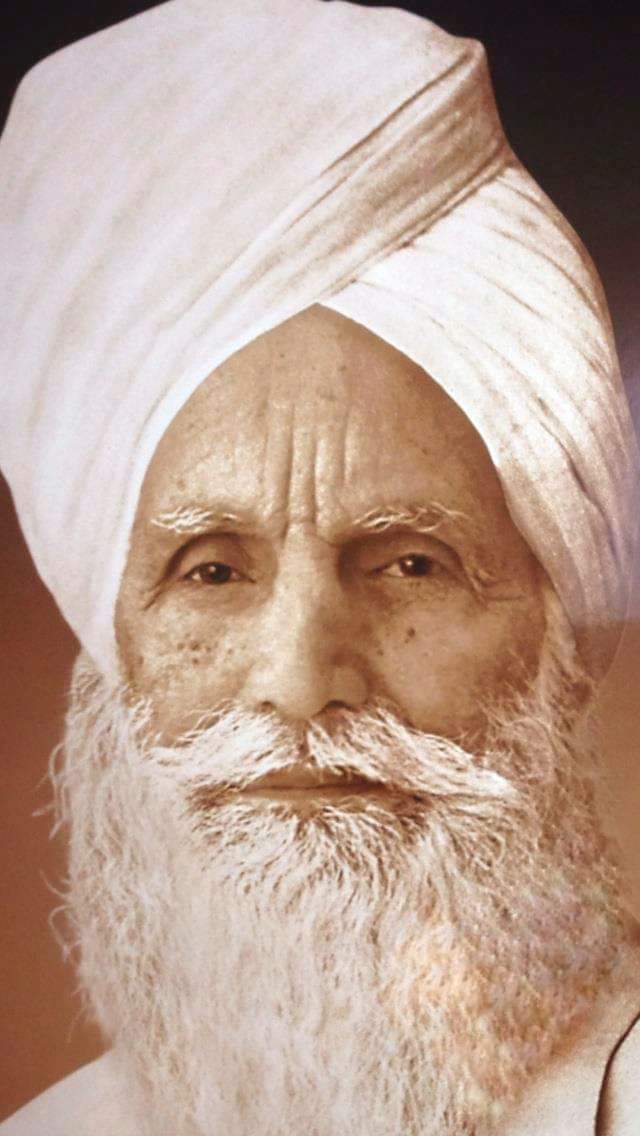
Origins of the Sant Tradition and Saints of the South, by James Bean

Referring to Sant Tulsi Sahib's origins: "He came from the south, and was popularly known as Dakhani Baba, which means 'Sage from the South'". (Tulsi Sahib, Saint of Hathras, J. R. Puri and V. K. Sethi, page 3, second edition, 1981)
With the Sant tradition of India the most famous Sants by far are the northern ones like Kabir, Nanak, Goswami Tulsi Das, Mirabai, etc... Lesser-known is the Sant tradition of Maharashtra as represented by Eknath, Namdev, Tukarama, Jnanadeva, and Samartha Ramadasa. There is however an even more obscure history of Sants in south India. The book, Saints of South India, Part One: Karnataka, by Dr. N. Subrahmanyam, P. Aravinda Rao, and K. G. Ramaprakash, published by the Beas satsang, features three prominent Sants of the south: Purandaradasa, Kanakadasa, and Shishunala Sharif Sahib. These were part of the Haridasas, the Haridasa branch of the Bhakti movement. More about them here: https://en.wikipedia.org/wiki/Haridasa
I've always been curious about when the Path of the Sants emerged in Indian history. Often people assume the Sants or Sant Mat began with poet-mystics such as Kabir or Nanak but clearly they were not the first Sants. Kabir is believed to have been born in 1440, Nanak 1469. Previous to the 15th century Sants and much earlier in the Sant tradition was Sant Jayadeva, born in east India during 1170, author of the Gita Govinda. Some of his compositions were also eventually included in the Sikh scriptures, the Adi Granth compiled in 1604. In Maharashtra were significant Bhakti Sants such as Jnaneshwar (1275-1296). A disciple and spiritual successor of Jnaneshwar was Visoba Khechar (unknown - 1309 CE), and Sant Namdev (1270-1350) was a famous disciple of Visoba Khechar.
Tracing the Sant tradition much further back in time I am rather intrigued by this statement in this book about the Saints of south India: "The Bhakti movement is thought to have originated in Tamil Nadu during the seventh century and eventually spread through Karnataka, Maharashtra, and then across India during the sixteenth-century." (Saints of South India, page 2) Tamil Nadu is the southernmost state of India.
This Wikipedia entry for the Bhakti movement pushes the date back to the 6th century: "The Bhakti movement was a significant religious movement in medieval Hinduism[1] that sought to bring religious reforms to all strata of society by adopting the method of devotion to achieve salvation.[2] Originating in Tamilakam during 6th century CE,[3][4] it gained prominence through the poems and teachings of the Vaishnava Alvars and Shaiva Nayanars in early medieval South India, before spreading northwards.[1] It swept over east and north India from the 15th century onwards, reaching its zenith between the 15th and 17th century CE." https://en.wikipedia.org/wiki/Bhakti_movement
The above paragraph at Wikipedia cites some credible sources that one may consult for further exploration of the history of Nirguna Bhakti Sants (devotees of the Formless Supreme Being) including: A Storm of Songs: India and the Idea of the Bhakti Movement, John Hawley, Harvard University Press, 2015; Bhakti Religion in North India: Community Identity and Political Action, David Lorenzen, State University of New York Press, 1995; and, The Sants: Studies in a Devotional Tradition of India, Karine Schomer, W.H. McLeod, Motilal Banarsidass, 1987)
I will have to research possible poet-Saints of the Tamil Nadu Sant tradition and explore what might be published in English from this earlier period.
Can we date the Sant tradition even earlier in the history of India? It's certainly the case that some ancient Upanishads taught about a Formless Purusha (Supreme Being), and have references to inner Light and Sound (Nada Yoga) meditation practices. In the Wiki entry cited above on the Bhakti movement is this paragraph: "Klaus Witz, in contrast, traces the history and nature of the Bhakti movement to the Upanishadic and the Vedanta foundations of Hinduism. He writes that in virtually every Bhakti movement poet, 'the Upanishadic teachings form an all-pervasive substratum, if not a basis.'"

As I wrote in my paper, The Origins Of Sant Mat, there are a few rare tantalizing references to Sants of antiquity:
Seeing references in Krishna/Vaishnava Hindu scriptures, Sant Tulsi Sahib of Hathras was of the opinion that the Sant movement dates back to the time of Krishna thousands of years ago, that Krishna knew of Sants during his day.
An Example of Sants Mentioned in a Hindu Scripture Called the Bhagavad Purana
"Such individuals who have achieved the unity of atman (soul) and Param-atman (Supreme Soul, God) are known as Sants. According to the Bhagavad Purana there is no one greater than a Sant in the eyes of the Divine. Lord Krishna says to his disciple Uddhava Ji: 'All devotees like you are very dear to me. They are dearer to me than Lord Brahma, Lord Shankara, my brother Bal Ram, Goddess Lakshmi and even my own soul. Therefore, I walk behind these Sants hoping that the dust arising from their holy feet would touch my body and purify me.'" (Hindu scripture quoted by Swami Vyasanand of the Tulsi Sahib/Maharshi Mehi Sant Mat lineage in his book, The Inward Journey of the Soul, Amazon Kindle e-book)
Some poetry from a biography of Dadu Dayal: "There is no end to the number of Sants who appeared in the Yugas [Epochs] of Sat, Treta, Dvapar, and Kali [Yuga]. I sing of the celebrated one I have heard of, and bow my head to all the others." (Jan Gopal, disciple of Sant Dadu Dayal of Rajasthan in, The Life Story of Dadu Dayal -- The Book of Janma Lila, translated into English by the scholar Winand M. Callewaert, in, The Hindi Biography of Dadu Dayal, Motilal Banarsidass)
For more see, The Origins of Sant Mat:
https://archive.org/details/the-origins-of-sant-mat/page/n1/mode/2up
Back to the recently published book on Sants of south India: "Purandara Dasa and Kanaka Dasa, lived in the sixteenth century, and are quite well known all over South India... Shishunala Sharif [19th century Sant], is not as well-known as the other two, but his teachings are nevertheless very profound. His background and poetry reminds one of Kabir." (Saints of South India - Part 1- Karnataka, 2024: https://scienceofthesoul.org/books-EN-279-1.html )
And, as the title implies, there likely will be a Part 2 volume exploring more southern Sants.
Baba Somanath of South India
A recent Sant based in south India was Baba Somanath (1885-1976) of the Radhasoami Satsang. "Baba Sawan Singhji was very pleased with Somanathji’s seva and behaviour and initiated him into the path of Surat Shabd Yoga in January 1928. He stayed at Beas for three and a half years, practicing Surat Shabd Yoga and achieved his cherished goal. In 1932, He sought the gracious permission of his Satguru to return to Mumbai. Sawan Singhji blessed him and commanded him to propagate the principles of Santmat in South India, where it was almost unknown." (from the Gurus section of the Sawan Durbar Ashram website: http://sdakengeri.org/Gurus.htm )
For the details of this see, The Life of Baba Somanath - Saint and Sage of South India, by Christopher McMahon, 2023: https://babasomanathji.org/biography/baba-jis-life-story
PDF:
https://babasomanathji.org/wp-content/uploads/2024/06/Life-Story-of-Baba-Somanath-Ji.pdf
And this biography is also available as a 323 page hardcover book by Christopher McMahon:
https://babasomanathji.org/for-further-information-contact
Baba Somanath was also one of the greatest bhajan singers of the 20th Century. You can hear recordings of many of his rather moving hymns here:
https://babasomanathji.org/bhajans