Powered By Blogger
Showing posts with label iraq. Show all posts

Saturday, May 06, 2017

PODCAST: The Mandaean Gnostic Scriptures and NDE's -- Spiritual Awakening Radio


PODCAST: The Mandaean Gnostic Scriptures and NDE's -- Spiritual Awakening Radio


MandaeanBookMan


PODCAST: The Mandaean Gnostic Scriptures and NDE's (Near-Death Experiences) -- Spiritual Awakening Radio With James Bean -- Listen @ Youtube:

Image: Ancient Mandaean art from Iraq, the Mandaean book-man illustrating that the scriptures are within, and to know thyself is true wisdom.

Some Mandaeans (literally, "possessors of secret Knowledge") live in Iraqi cities like Baghdad and Basra. There's a large Mandaean population that resides in smaller market towns and villages of the marshland in southern Iraq, and near the Euphrates and Tigris rivers. Iran also has a Mandaean population; many of them dwell along the river Karun in Rhuzistan province. These days, many Mandaeans are relocating to western countries.

The Prophet Mohammed called them "Sabians," i.e. "Baptists or baptizers," a name which occurs in the Quran and which enabled them to continue under Islam. Islam also categorized them as "a people of the book," a religion that possesses their own ancient scriptures. Another factor that has traditionally enabled them to operate in the Islamic world is their affiliation with John the Baptist. John the Baptist is one of their greatest prophets.

Though the historic connection between John and the Mandaeans is hard to verify, it is indeed possible they are descendants of disciples of John the Baptist, who 2,000 years ago had a large number of followers which believed him to be a great Master and Prophet, if not the awaited Messiah. After John's death, the New Testament portrays Jesus as being the spiritual successor, but other leaders in John's community might have seen things differently. Like Jesus, others might also have claimed to be John's successor and thus would have become the leaders of a John-community that maintained its independence from the Jesus Movement, instead remaining what they were -- an unorthodox baptismal sect of the Trans-Jordan.

According to scholars of Mandaean studies like Werner Foerster, indeed the origins of the Mandaeans do go back to the Jewish tradition of first century AD Palestine and the region of the Jordan River. Foerster states in Gnosis II, published by Oxford University Press, that in the context of the Jewish war of independence and the consolidation of Orthodox Judaism after AD 70, "its position as a minority opposition evidently led to the persecution of the community and finally to its emigration from its native Jordan territory to the east, to begin with in Harran and the median hill country, then in the southern regions of Mesopotamia." Eventually the community settled in the region of the Tigris and Euphrates rivers, where they could continue the ritual of baptizing initiates in "living waters" (rivers) symbolizing the connecting of their souls with "heavenly Jordan rivers of Light."

The role of the Heavenly Messenger is to give the mystic experience of light to souls and eventually guide them back up to the Place of Light, the Mandaean term for the highest heaven where the Great Life (God) resides. 

The mystical encounters recorded in the scriptures of the Mandaeans may seem at times like ancient near-death experiences (NDE's), the visions of souls who were embraced by the Light long ago.

God is the Ocean of Love and All-Consciousness.

In Divine Light and Sound, Namaste', Gnosis, Peace, Jai Guru, Jai Sat Naam, Bandagi Saheb, Satya Raam, Radhasoami, 
James

* Website:

* Like the Sant Mat Radhaswami Page at Facebook:

* Introduction to Sant Mat Spirituality and Meditation:

* The Sant Mat Radhasoami Blog and Satsang E-Newsletter:


Wednesday, September 21, 2016

PODCAST: The Mandaean Gnostic Scriptures -- Spiritual Awakening Radio With James Bean


PODCAST: The Mandaean Gnostic Scriptures -- Spiritual Awakening Radio With James Bean: 
https://www.youtube.com/watch?v=jUWdAktf4eI&list=PLqzXkcs_2TwAvbR6ev3goFSbDBj8FnRS8


Some Mandaeans (literally, "possessors of secret Knowledge") live in Iraqi cities like Baghdad and Basra. There's a large Mandaean population that resides in smaller market towns and villages of the marshland in southern Iraq, and near the Euphrates and Tigris rivers. Iran also has a Mandaean population; many of them dwell along the river Karun in Rhuzistan province. These days, many Mandaeans are relocating to western countries.

The Prophet Mohammed called them "Sabians," i.e. "Baptists or baptizers," a name which occurs in the Quran and which enabled them to continue under Islam. Islam also categorized them as "a people of the book," a religion that possesses their own ancient scriptures. Another factor that has traditionally enabled them to operate in the Islamic world is their affiliation with John the Baptist. John the Baptist is one of their greatest prophets.

Though the historic connection between John and the Mandaeans is hard to verify, it is indeed possible they are descendants of disciples of John the Baptist, who 2,000 years ago had a large number of followers which believed him to be a great Master and Prophet, if not the awaited Messiah. After John's death, the New Testament portrays Jesus as being the spiritual successor, but other leaders in John's community might have seen things differently. Like Jesus, others might also have claimed to be John's successor and thus would have become the leaders of a John-community that maintained its independence from the Jesus Movement, instead remaining what they were -- an unorthodox baptismal sect of the Trans-Jordan.

According to scholars of Mandaean studies like Werner Foerster, indeed the origins of the Mandaeans do go back to the Jewish tradition of first century AD Palestine and the region of the Jordan River. Foerster states in Gnosis II, published by Oxford University Press, that in the context of the Jewish war of independence and the consolidation of Orthodox Judaism after AD 70, "its position as a minority opposition evidently led to the persecution of the community and finally to its emigration from its native Jordan territory to the east, to begin with in Harran and the median hill country, then in the southern regions of Mesopotamia." Eventually the community settled in the region of the Tigris and Euphrates rivers, where they could continue the ritual of baptizing initiates in "living waters" (rivers) symbolizing the connecting of their souls with "heavenly Jordan rivers of Light."

The role of the Heavenly Messenger is to give the mystic experience of light to souls and eventually guide them back up to the Place of Light, the Mandaean term for the highest heaven where the
Great Life (God) resides.


The mystical encounters recorded in the scriptures of the Mandaeans may seem at times like ancient near-death experiences (NDE's), the visions of souls who were embraced the Light long ago.

Subscribe To Podcasts For Free: Podcast Download Page:
https://spiritualawakeningradio.libsyn.com

All for the love of wisdom and radio,
James
Website:
http://www.SpiritualAwakeningRadio.com
About Me:
https://about.me/SpiritualAwakeningRadio


Monday, August 29, 2011

The Mandaean Religion of Iraq - Exploring the World Religions


The Mandaean Religion of Iraq - Exploring the World Religions
By James Bean
Copyright January 1998 - All Rights Reserved
 
 
The story of the Mandaeans (Man-day-yens) somewhat resembles the experience of Native American tribes; may they survive; may their ancient wisdom be shared with humanity.
 
In the 1970's professor Kurt Rudolph wrote his definitive book on the nature and history of the Gnostic religion called, "Gnosis." In the chapter titled, "A Relic: the Mandaeans," he recorded that at the time there were only about 15,000 Mandaeans left and the number of Mandaean priests were rapidly dwindling. He described them as a community in somewhat of a state of crisis not only due to a shortage of priests but also because of the growing spiritual and cultural gap between the elders (who are the keepers of the ancient Knowledge) and the younger generations of Mandaean laity. Kurt Rudolph wrote, "The continued existence of the community will essentially depend on whether or not it succeeds in solving the problem of a necessary adaptation to the modern world. Only in this way will the oldest Gnostic religion, with its two millennia of history in which it developed its independent Aramaic idiom and lifestyle as did no other Gnostic sect of the past, be able to survive in the future." ("Gnosis," Harper Collins) And those words were written long before the rise of Saddam Hussein, the Gulf War, and the current madness that has cursed that region for many years.
 
Some Mandaeans (literally, "possessors of secret Knowledge") live in Iraqi cities like Baghdad and Basra. There's a large Mandaean population that resides in smaller market towns and villages of the marshland in southern Iraq, and near the Euphrates and Tigris rivers. Iran also has a Mandaean population; many of them dwell along the river Karun in Rhuzistan province. The Prophet Mohammed called them "Sabians," i.e. "baptists or "baptizers," a name which occurs in the Quran and which enabled them to continue under Islam. Islam also categorized them as "a people of the book," a religion that possesses their own ancient scriptures. Another factor that has traditionally enabled them to operate in the Islamic world is their affiliation with John the Baptist. John the Baptist is one of their greatest prophets.
 
Though the historic connection between John and the Mandaeans is hard to verify, it is indeed possible they are descendents of disciples of John the Baptist, who 2,000 years ago had a large number of followers which believed him to be a great Master if not the awaited Messiah. After John's death, the New Testament portrays Jesus as being the spiritual successor, but other leaders in John's community might have seen things differently. Like Jesus, others might also have claimed to be John's successor and thus would have become the leaders of a John-community that maintained it's independence from the Jesus Movement, instead remaining what they were -- an unorthodox baptismal sect of the Trans-Jordan.
 
 
According to scholars of Mandaean studies like Werner Foerster, indeed the origins of the Mandaeans do go back to the Jewish tradition of first century AD Palestine and the region of the Jordan river. Foerster states in "Gnosis II," published by Oxford University Press, that in the context of the Jewish war of independence and the consolidation of Orthodox Judaism after AD 70, "its position as a minority opposition evidently led to the persecution of the community and finally to its emigration from its native Jordan territory to the east, to begin with in Harran and the median hill country, then in the southern regions of Mesopotamia." Eventually the community settled in the region of the Tigris and Euphrates rivers, where they could continue the ritual of baptizing initiates in "living waters" (rivers) symbolizing the connecting of their souls with "heavenly Jordan rivers of Light."
 
 
FAMILIAR-SOUNDING NEW TESTAMENT-ISH OR JESUS-LIKE SAYINGS
 
This ancient religious community, also known as the Nazoreans, still uses a dialect of the Aramaic language; they possess a huge quantity of wonderful scriptures, mostly in the form of psalms or hymns.
 
Before I begin a study of some visionary writings in the Mandaean scriptures I want to share some examples of passages that sound somewhat "familiar" to our ears -- new testament or Jesus-like passages. These would be words spoken by those who came from the same Aramaic-speaking Semitic milieu as did Jesus and other Messiahs of the middle east:
 
"I am a shepherd who loves his sheep; 
I protect the sheep and the lambs...
I carry them and give them water to drink 
from the hollow of my hand 
until they have drunk their fill."
 
"A fisherman am I, 
who am the elect 
among the fisherman, 
the chief of all the fish-catchers."
 
"Give bread, water and shelter to the poor 
and persecuted people who suffer persecution."
 
"Love and support one another."
 
"When you see anyone who is hungry, 
then satisfy his hunger. 
When you see anyone who is thirsty, 
then give him to drink, 
for whosoever gives, receives."
 
"Whoever releases a prisoner will find 
a Messenger of Life advancing
to meet him."
 
"My chosen! Do not put your trust 
in the kings, rulers, and rebels of this world, 
nor in military forces, arms, conflict, 
and the hosts which they assemble, 
nor in silver and gold...
their gold and their silver 
will not save them. 
Their authority passes away 
and comes to an end."
 
The words "seek and you will find" appear on numerous occasions in the Mandaean scriptures as well, in fact, much more often than in the New Testament. And, the term "Place of Life," often used in the Mandaean texts, also appears in the Gospel of Thomas.
 
 
THE FIRST WAVE OF GNOSIS
 
There was some kind of transformation in thinking that took place 2,000 years ago in the middle east which lead to the birth of scores of new religious movements both within and outside of Judaism, including the Sethians, the Essenes, and various forms and expressions of Christianity. Many of these are categorized as "Gnostic," meaning they focused upon spiritual/mystical Knowledge. This was the time of the first wave of Gnosis in the western world -- the spark was lit. Some souls started to believe that it was possible for them personally to KNOW the Mysteries of God and the Heavens, and they sought spiritual wisdom & guidance from various masters, mystics, prophets and apostles that were around at that time. For the Nazoreans (Mandaeans), John the Baptist was God's Teacher who had been sent "from the Light" to baptize or initiate souls into the experience of the Knowledge of Life, the "Great Life," a Name for God in the Mandaean scriptures.
 
There are some examples of visionary literature in the Dead Sea Scrolls, various descriptions of things going on in the heavens. The Mandaean texts seem to be a continuation of that visionary tradition of Light-mysticism and Ascension-mysticism. In my view the Mandaean scriptures probably represent the most heavenly or otherworldly documents of the west, brimming with out-of-this-world visions of God, descriptions of the heavens, souls, angels, and life after death. They speak directly to both the heart and soul of the reader through hymns and prayers of incredible beauty.
 
 
THE COMING OF THE MESSENGER OF LIGHT
 
The role of the Heavenly Messenger is to give the mystic experience of LIGHT to souls and eventually guide them back up to the Place of Light, the Mandaean term for the highest heaven where the Great Life (God) resides. Here are a couple of passages from Mandaean holy books on Manda-d-Hiya -- the great heavenly redeemer:
 
The Illuminator of the Worlds of Light
 
IN THE NAME OF THE GREAT LIFE,
SUBLIME LIGHT BE PRAISED
 
"From the Place of Light I came forth,
from you, Bright Habitation.
I come to touch hearts,
to measure and try all minds,
to see in whose heart I dwell.
Whoever thinks of me, of him I think;
whoever calls my Name, his name I will call.
Whosoever prays my prayer from the earth,
his prayer I will offer from the Place of Light.
 
"I came and found the truthful 
and believing hearts.
When I was not dwelling among them,
yet my Name was on their lips.
I took them and guided them up 
to the World of Light.
 
"I became the Illuminator 
of the Worlds of Light.
I became a king to the Nazoreans, 
who receive praise and stability 
through my Name.
And by my Name they ascend 
to the Place of the Light.
As for the elect righteous 
who put me on as a garment,
their eyes were filled with Light,
and Manda-d-Hiya [Knowledge of Life] 
was established in their hearts."
 
 
EMBRACED BY THE LIGHT
 
The mystical encounters recorded in the scriptures of the Mandaeans may seem at times like ancient near-death experiences (NDE's), the visions of souls who were embraced the Light long ago:
 
"When I arrived at the water-brooks, 
a discharge of Radiance met me.
It took me by the palm of my right hand 
and brought me over the streams of death. 
Radiance was brought and I was clothed in it.
Light was brought and I was wrapped in it...
 
"[Prayer] Son of the Good Ones, 
show me the way of the divine beings
(spirits, angels) and the ascent upon 
which your father rose up to
the Place of Light.
 
"He [the discharge of Radiance] rose 
and took me with him 
and did not leave me 
in the perishable dwelling." 
(Canonical Prayerbook)
 
This is my interpretation. In the above account, after this soul crossed over to the other side, it was met by a "discharge of Radiance," (according to another translation) a deliverer or guide who not only escorted the soul into the beyond, but also gave the soul its heavenly robe of Radiance -- a garment made of Light. It's unclear to me if the soul literally was given a robe to put on, or if perhaps this is another way of describing the process of leaving the body at death, taking OFF the robe of the physical body, which caused the soul to see itself as a being of Light. In any event, the soul then prays for its helper and guide to be escorted upward to the Place of Light. In another version of this account it says:
 
"I lifted mine eyes to heaven and my soul 
waited on the House of Life.
And the Life (God) who heard my cry 
sent toward me a deliverer."
 
This version also describes the encounter with the heavenly being (discharge of Radiance) who escorted the soul over the waters of death, and accompanied it during the ascension up to the Light-world. The hymn concludes with these words:
 
"Life supported life, Life found its own. 
Its own self did Life find,
and my soul found that 
for which it had looked. 
Renowned is Life
and victorious." 
(Canonical Prayerbook)
 
 
VISIONS OF THE GREAT LIFE IN THE PLACE OF THE LIGHT
 
Souls in the Place of the Light are described as luminous beings living in a world of infinite Light with a Supreme Being of Light. The heavens of hyperspace are traversed by spiritual streams of "Living Waters," tributaries of the Heavenly Jordan river of Light. And souls are described as radiant beings that shine upon each other like stars do in the center of our galaxy:
 
"They are a thousand thousand miles 
distant from one another 
and yet one is illumined 
by the other's Radiance."
 
The primary name for the highest God in the Mandaean tradition is "The Great Life." Many of the hymns in the Canonical Prayerbook begin with this invocation:
 
"In the Name of the Great Life,
Sublime Light be Praised."
 
"Living One," a term found in the Gospel of Thomas and in eastern Gnostic writings, is used in Mandaean texts for God. The Great Life is also referred to as the King of Light, a limitless Radiant Being of compassion and love:
 
"He is the Light, in Whom is no darkness,
the Living One, in Whom is no death,
the Good One, in Whom is no malice,
the Gentle One, in Whom is no confusion,
the Kind One, in whom is no venom of
bitterness." (Gnosis II)
 
The term "Great Spirit" is also used on several occasions in the Mandaean scriptures. ////////


Thursday, December 13, 2007

The LOST Books of the Bible


Spoken recently by James Bean on his radio program called Spiritual Awakening. Which features spiritual book reviews and readings from the writings of many mystics, saints and world scriptures of the East and West.

"Transmigration is another word for reincarnation. It is a very Eastern term. You don't hear it that often in the Bible, because the Bible is also not always complete, as all of you know. It has "transmigrated" for 2,000 years or some time, so some things may be missing there. The true Bible is locked up somewhere and we are never allowed to see it. But some of the newly-dug from ancient sites _ the Bible in some part has come out, and some of it mentions reincarnation." (SCNews 60)

Based on my exploration of the lost books of the Bible, I that comment to be quite accurate. During the last 200 years many ancient Jewish and Christian documents have been rediscovered in the Middle East. And, I should mention that some Christians have been curious about apocryphal scriptures and have preserved some of these "other books" of the Bible for 2,000 years. Many other interesting collections of psalms, letters (epistles), gospels and revelations have survived the centuries, even though only a small number of open-minded seekers have valued their spiritual wisdom.

I want to share with you my encounter with the books of the other Bible. I want to impart to you information about books of mystical poetry, discourses on gaining enlightenment and other amazing documents which might be very helpful to you on your spiritual journey. It's time that this knowledge is revealed so anyone can know how to find the lost or hidden books of the Bible!

A long time ago when I was involved in making a major study of the Bible (the Hebrew Scriptures and the New Testament), I noticed that Catholic Bibles contain several additional books that aren't in the Protestant Bible. These books are called "the Apocrypha" in the Protestant tradition. Although the original King James Version of 1611 AD did contain these books, it seems that Protestant Bible societies took them out of the Bible a couple hundred years ago to make smaller, cheaper Bibles available to the masses. Today most Protestants think of these disputed books as "Catholic" but, the truth of the matter is the books of "the Apocrypha" for millennia have also traditionally been included in the old Bibles of the Greek Orthodox, Syrian, Russian, Armenian, Egyptian and all other ancient churches.

Translations of most of these books were also found amongst the Dead Sea Scrolls. The original Greek translation of the Old Testament made in Alexandria around 200 BC also included these other books -- books that have now vanished from the Protestant Bibles in the US!

From my perspective, the two most interesting books of "the Apocrypha" are The Wisdom of Solomon and The Wisdom of Sirach -- two very large collections of proverbs and wise sayings very comparable to the Tao Te Ching by Lao Tzu. Many people think that the Bible as we know it was put together by Jesus and the apostles during the 1st century AD but, that's definitely not so! For a longer period of time than the US has been a country -- for centuries -- the early Church had no such concept as a closed canon of scripture, a collection of books that they viewed as the "final" or "only" revelation concerning spiritual matters. Rather, Christians during that creative period felt free to compose new scriptures, psalms, odes, proverbs, letters that they felt were inspired, and other documents of a spiritual nature. This was during the early years when Christianity had living apostles and saints, and Christianity was a much more supernatural religion; a mystery religion that put a great deal of emphasis on experiencing the Kingdom of God, or the spiritual realm.

RIGGING THE CURRICULUM

Christianity, like other religions, underwent the process of "mainstreaming" -- settling down or crystallizing -- into a standardized, organized faith. The mainstream consciousness came to believe that "the age of the apostles and prophets was now past." So, since masters and saints (who acted as oracles of the Divine) were no longer being recognized by the masses, some people started to look to past masters for guidance. Christianity entered the stage where the Book became the master, the Book became the guru. The state church of the Emperor Constantine created a fixed list of books which would serve for all time as the rule of faith. They also made lists of books that were to be weeded out of circulation, no longer to be considered as scripture. This process of canonization and censorship, for the most part, happened during the fourth century. It was during this time that most of the "other books" lost their status as scripture. Only a small number of books made it into the this fourth century Bible and sadly, many important mystical books were left out.

EXAMPLES OF DELETED SCRIPTURES

Many years ago when I was reading the New Testament book of Jude I discovered an amazing quote -- a quote which opened me up to the other books of the Bible. Jude, in verse 14 of this short book preserved in the New Testament, quoted from the book of First Enoch 1:9. He also quoted another found in the Hebrew scriptures called the Testament of the Twelve Patriarchs. I was amazed to find out about the existence of these other books and decided that if Jude, during the 1st century, had access to them, then I wanted to check them out myself! So I started to collect apocryphal writings once considered to be scripture.

The term "apocryphal books" has three basic definitions: 1) secret or hidden writings of an esoteric nature; 2) books not considered inspired by the church but are, nonetheless uplifting to read; or 3) fictitious writings or fantastic stories. In existence are hundreds of apocryphal books representing all three categories. I've tried to collect all of the available apocryphal writings and have found a number of important books amongst them that contain absolutely essential spiritual instruction.

The Books of Enoch are part of the Ethiopian Bible and among the Dead Sea Scrolls. They describe the heavenly journeys of Enoch, the prophet, through the Seven Heavens! Like Hermes Trismegistus of Egypt and the great Medieval mystic Kabir from India, the Jewish prophet Enoch described his visions of the higher planes.

THE ODES OF SOLOMON — NEW TESTAMENT PSALMS

Out of all the apocryphal writings I've collected, I think the Odes of Solomon is the most beautiful. It is the would-be book of New Testament psalms! The Book of the Odes has been described as the first known hymn book of early Christianity. One scholar said of the Odes, "Here are some of the most beautiful songs of peace and joy that the world possesses." Bentley Layton in The Gnostic Scriptures says that the Odes were considered to be inspired scripture and were chanted by Christians who lived in Syria and Mesopotamia about 2,000 years ago. A follower of the Unity School of Christianity published an edition of the Odes a few years back and created daily affirmations based on this ancient book. These ecstatic hymns remind me of Sufi love poetry in the tradition of "the lover and the Beloved". Many have adopted the practice of meditating upon the Odes and report being brought to a deeper level of devotion (bhakti); being caught up in a love-affair with God, the Ocean of Love. That's also been my experience.

"There is no hard way where there is a simple heart,
Good thought finds no wounds,
Nor is there any storm in the depths of illuminated thought.

Surrounded on every side by the beauty of the open country,
one is free of doubt.

Below
is like above." (from Ode 34)

"Open your ears, and I shall speak to you;
Give me yourself, so that I too may give you myself."(Ode 9)

"He filled me with words of truth
that I may speak the same.

Like the flow of waters truth flows from my mouth,
and my lips reveal its harvest,

and it gives me the gold of knowledge
for the mouth of the Lord is the true Word
and the Door of His Light.

And the highest one gave the Word to His worlds,
which interpret His own beauty,
recite His praise,
confess His thought,
are heralds of His mind,
are instructors of His works.

For the swiftness of the Word is ineffable
and like His statement are its swiftness and sharpness.

Its course knows no end,
it never fails, it stands.
Its descent and its way are incomprehensible.

Like His work is its end
for it is the Light and the dawn of thought,

and through it worlds converse...

The mouth of the highest one spoke to them
and he was made clear by His Word.

The dwelling place of the Word is man
and its truth is love." (Ode 12)

The Book of Odes even contains some passages which describe the feminine aspect of the Godhead! "

I rested on the Spirit of the Lord and She lifted me up to heaven,"

THE GOSPEL ACCORDING TO MARY MAGDALENE

The Gospel of Mary was one of the ancient books found in 1945 near Nag Hammadi, Egypt. The preeminence of Mary Magdalene in this Gospel gives one example of the leadership roles of women in early Christianity. Mary is described as an apostle, equal in every way to the twelve apostles and part of the inner circle of Jesus. But more than that, Mary was a kind of spiritual successor to Christ, taking over His role as the spiritual teacher of the other disciples. In every way, the text affirms that her leadership of the other disciples is based upon superior spiritual understanding.

As a recipient of the secret teachings of the resurrected Christ, Mary, in her Gospel teaches the other disciples spiritual knowledge and gives detailed accounts of her visions and travels through the higher planes or heavens accompanied by the radiant form of her Master, the resurrected Christ. She relays to the other disciples the spiritual instructions, the words of Christ that she heard during these encounters, which probably took place during times of deep prayer -- long periods of meditation.

THE ACTS OF PAUL AND THECLA

Speaking of women apostles and saints in early Christianity: The Acts of Paul and Thecla, is the record of the life and times of Thecla, a follower of Saint Paul, the apostle. This book is brimming with accounts of many supernatural and miraculous events during the life of Thecla, very much calling to mind the Desert Fathers and Mothers of Egypt.

This book describes Thecla as "an apostle of God," who, sometimes traveled and at other times lived a monastic life in a cave. She was also a spiritual leader and teacher who instructed people "in the oracles of God". The text records that "many of them abandoned this world, and lead a monastic life with her." She was so highly esteemed that a temple was erected and dedicated to her!

THE BOOK OF PISTIS SOPHIA (FAITH-WISDOM)

After studying the four Gospels of the New Testament I became very curious and puzzled about how each of them concluded. Each of them only devotes a short chapter or two to the teachings and activities of Christ after the resurrection. Logically, wouldn't you think that if someone rises from the dead, that this would immediately become the central, electrifying event that becomes the main focus, if not the obsession of the writers to record these events with extreme detail? Wouldn't you think that the words and deeds of the resurrected Christ would deserve to be the focus of many chapters, if not entire books? And yet, the New Testament simply (and cryptically) says that "there were many other things that Jesus did," and that "He continued to appear to the disciples and instruct them about the Kingdom of God."

Apparently the post-resurrection teachings of Christ were regarded by the disciples as private or advanced, meant only for those followers who were ready for a deeper commitment to contemplation and the spiritual journey. Though they are more difficult to find, there are other documents that do contain post-resurrection teachings including: The Book of the Resurrection, The Gospel of Mary, Gospel of Thomas, Dialogue of the Savior, The Gospel of James, The Books of Jeu, The Letter of Peter to Philip and The Book of Pistis Sophia (Faith-Wisdom).

The largest Gospel ever discovered, Pistis Sophia, was brought to London from Egypt and purchased in 1772 by A. Askew, a London doctor and collector of old manuscripts. The book was published and one of its most famous readers was the great poet-mystic William Blake, who was greatly influenced by it.

This text does document that there was a time when some Christians did believe in the concept of reincarnation and the preexistence of the soul. Like St. Paul's "Damascus Road experience" recorded in the New Testament, Christ is said to have appeared to His followers from inside an incredibly brilliant light and many rays of light. Many interesting dialogues between Christ and His initiates are recorded in this document -- about eleven years-worth! Pistis Sophia also contains many beautiful hymns and prayers. Though reincarnation is mentioned as a reality, the goal of the teachings was to liberate souls from material captivity, reincarnation, the wheel of fate and encumbrances of darkness. Ignorance of the spiritual world was to be replaced with spiritual freedom and souls were given the ability to travel from Earth to Heaven via the Holy Stream of Light: "Seek, all of you, after the Light, so that the power of your soul that is in you may live. Do not cease seeking day or night until you find the mysteries of the Kingdom of Light, which will purify you, make you into pure light and lead you into the Kingdom of Light." This inner vision took place during periods of solitude and contemplation (meditation).

THE NAG HAMMADI LIBRARY UNEARTHED IN EGYPT!

A number of ancient mystical books were discovered near the city of Nag Hammadi in Upper Egypt. This almost 2,000 year old "time capsule" (a large sealed storage jar containing parchments written in the Coptic language buried by monks during the fourth century) now known as the Nag Hammadi Library, has set in motion a spiritual revolution. Buried under the sands of Egypt for centuries, these censored and forgotten scriptures from the early years of Gnostic Christianity may impart to spiritual seekers of today, knowledge of several mystical traditions that once existed in the West. This ancient library contains spiritual discourses from Christian, Gnostic, Jewish, Pythagorean, Hermetic and other spiritual movements. What have been returned to us are the teachings of various mystics, Gnostics who initiated their students into the "Mysteries of the Kingdom of Light," and wrote down descriptions of their otherworldly journeys into inner space. One of the most talked about books of the Nag Hammadi Library is The Gospel of Thomas, a collection of the spiritual sayings of Jesus on gaining enlightenment.

SAYINGS OF JESUS ABOUT THE LIGHT AND SOUND

The Gospel of Thomas is a "sayings Gospel," a collection of the proverbs and parables of Christ about discovering the Kingdom of God. The theme of these sutras of wisdom is that the Supreme Being is Light, our soul is made of Light, and that by contemplating the Living Light we can reenter paradise.

In the Book of Thomas it is recorded that Jesus was a Master who taught His disciples that "we have come from the Light, from the place where the Light came into being by itself...there is Light within a person of Light, and it shines on the whole world;" and "if one is whole, one will be filled with Light." Also, "He who will drink from my mouth will become like Me; I myself shall become that person, and the hidden things will be revealed to that person." The image of drinking from the mouth of Christ is describing the process of listening to the Sound, Word or Cosmic Voice of God which transforms the listeners, transporting them to the higher or hidden realities. The quotes are from The Gospel of Thomas, Marvin Meyer, published by Harper Collins.

LIGHT MYSTICISM OF THE GNOSTICS, THEN AND NOW

One of the central teachings of Gnostic saints was the experience of the inner Light. In fact, having visions of divine Light is a universal experience. People around the world in all cultures have recorded visions of Heaven and encounters with "the Light within". Many have eloquently described in their sacred texts encounters with Light coming from beyond the darkness. Many saints and mystics, including those who wrote various Nag Hammadi texts, describe God or the Supreme Being as a GOD OF ALL-ENCOMPASSING, PURE, BRILLIANT LIGHT. They also believe that we, as souls (our true spiritual identity) are "sparks of the Light," that we are, in reality, "Children of the Light".

The experience of Light mysticism (seeing inner Light) takes place during one's time of contemplative prayer, or meditation. "The rays of primordial Light that illumine purified souls with spiritual knowledge not only fills them with benediction and luminosity; they also, by means of contemplation of the inner essences of created things, lead them up to the Noetic heavens. For this reason Saint Neilos says, "The intellect's proper state is a noetic height, somewhat resembling the sky's hue, which is filled with the Light of the Holy Trinity during the time of prayer." (The Philokalia, Volume IV, writings of Greek Saints, Faber and Faber Books)

"God is Light, and in Him there is no darkness." And, "Blessed are the pure in heart, for they will see God." (The New Testament)

"Understand what the Great Light is." (Nag Hammadi Library In English, Harper Collins)

"I AM the Light that is over all things." (Gospel of Thomas)

"Then we went up to the sixth heaven. And I gazed up on high and saw a great Light shining down on the sixth heaven." ("The Apocalypse of Paul," Nag Nammadi Library In English)

It says in The Dead Sea Scrolls _ A New Translation, Harper Collins, "From the Fount of His Knowledge has my Light shot forth; upon His wonders has my eye gazed."

Also, "Your Holy Spirit illuminates the dark places of the heart of your servant with Light like the sun."

Further to the East, the medieval Saint (Sant) Kabir said, "The light of the soul is equal to that of sixteen suns."

The Mandaean Religion of Iraq has many beautiful hymns and prayers to the Light, and visions of Heaven that often resemble NDEs (modern day near death accounts): "His Light illuminates and His radiance irradiates all the worlds, and the divine beings who stand before Him and shine in their radiance and in the radiance of the Great Light which rests upon them."

Pistis Sophia is published by E. J. Brill Books. Enoch, Odes of Solomon and Thecla are found in The Lost Books of the Bible and the Forgotten Books of Eden, Meridian, an imprint of Penguin Books. The Books of Thomas, Mary, James, and others are found in The Complete Gospels, Polebridge Press. An excellent anthology of apocrypha that I highly recommend is The Other Bible, published by Harper Collins! Other good books include: The New Jerusalem Bible (with the Apocrypha), Doubleday; and, The Nag Hammadi Library In English, Harper Collins Books.

As you can see from this brief sampling of apocryphal scriptures, the books that were left out of the fourth century Bible tended to promote personal spiritual experience and contemplation. This earlier spiritual tradition was never fully embraced in the West and that is the reason, in my view, why these other books were left behind.

Long ago, a great poet-mystic said, "The god of time (maya) has put a cover over the teachings of saints and thus concealed them from humanity."


Wednesday, April 25, 2007

Ancient Near-Death Experiences in Mandaean Scriptures


Ancient Near-Death Experiences in Mandaean Scriptures
Copyright January 1997
By James Bean


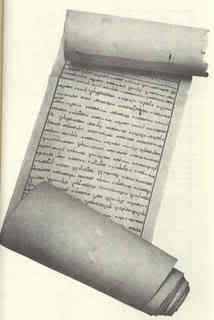
Photo of a Mandaean Scroll written in Mandaic, a dialect of Aramaic

The following is found in the Mandaean Gnostic scriptures of Iraq. They sound somewhat like ancient NDEs or near-death experiences. When crossing over, the soul meets "a discharge of Radiance." This inner guide brought the ascending soul a garment made of Light, often a theme in Mandaean and in Mesopotamian traditions (Books of Adam and Eve, Hymn of the Pearl in the Acts of Thomas). The soul was escorted by this heavenly guide to "the Place of Light" where God, called "the Great Life," resides. The soul is then 'embraced by the Light.'

EMBRACED BY THE LIGHT

The mystical encounters recorded in the scriptures of the Mandaeans may seem at times like ancient near-death experiences (NDE's), the visions of souls who were embraced the Light long ago:

"When I arrived at the water-brooks, a discharge of Radiance met me. It took me by the palm of my right hand and brought me over the streams of death. Radiance was brought and I was clothed in it. Light was brought and I was wrapped in it...

"[Prayer] Son of the Good Ones, show me the way of the divine beings (spirits, angels) and the ascent upon which your father rose up to the Place of Light.

"He [the discharge of Radiance] rose and took me with him and did not leave me in the perishable dwelling." (Canonical Prayerbook)
 

This is my interpretation. In the above account, after this soul crossed over to the other side, it was met by a "discharge of Radiance," (according to another translation) a deliverer or guide who not only escorted the soul into the beyond, but also gave the soul its heavenly robe of Radiance -- a garment made of Light. It's unclear to me if the soul literally was given a robe to put on, or if perhaps this is another way of describing the process of leaving the body at death, taking OFF the robe of the physical body, which caused the soul to see itself as a being of Light. In any event, the soul then prays for its helper and guide to be escorted upward to the Place of Light. In another version of this account it says:

"I lifted mine eyes to heaven and my soul waited on the House of Life. And the Life (God) who heard my cry sent toward me a deliverer."

This version also describes the encounter with the heavenly being (discharge of Radiance) who escorted the soul over the waters of death, and accompanied it during the ascension up to the Light-world. The hymn concludes with these words:

"Life supported life, Life found its own. Its own self did Life find, and my soul found that for which it had looked. Renowned is Life and victorious." (Canonical Prayerbook)

VISIONS OF THE GREAT LIFE IN THE PLACE OF THE LIGHT

Souls in the Place of the Light are described as luminous beings living in a world of infinite Light with a Supreme Being of Light. The heavens of hyperspace are traversed by spiritual streams of "Living Waters," tributaries of the Heavenly Jordan river of Light. And souls are described as radiant beings that shine upon each other like stars do in the center of our galaxy:

"They are a thousand thousand miles distant from one another and yet one is illumined by the other's Radiance."

The primary name for the highest God in the Mandaean tradition is "The Great Life." Many of the hymns in the Canonical Prayerbook begin with this invocation:

"In the Name of the Great Life, Sublime Light be Praised."

More Visions of the Beyond in the Mandaean Gnostic Scriptures of Iraq

"The jordan's of the worlds of Light are full of white waters, whiter than milk, cool and tasty, and their aroma is stronger than the great aromatic vines...

"Those beings of Light are made up of many kinds and fall into earths, skinas [abodes], jordans, trees, uthras [good beings of Light], and angels, as well as radiance, Light, and brightness which rest upon them.

"Their form is luminous and bright and the look of their faces is clear and bright like pure beryl. Every day strength and voice, utterance and victory are planted by the King of all the worlds of Light and sent to them...

"They are clothed in garments of Radiance and are arrayed in a covering of Light. They sit and dwell together, without offending one another and without sinning against one another. They are honored in their firmament and match as the eyelash the eye. Their thoughts are open to one another, and they know the First and the Last. They are a thousand thousand miles distant from one another and yet one is illumined by the other's radiance, one is fragrant through another's fragrance..."

-- "Gnosis II," Werner Forester, Oxford University Press, out of print